
What to wear in 80 degree weather, 80 °F (26.7 °C): light, loose clothes in linen or cotton. For example, a T-shirt with shorts, a skirt, a light dress or thin pants, and sandals or sneakers. Add a brimmed hat and sunglasses, and carry a light layer for the morning. In the NOAA 1991-2020 climate normals, 32 of 34 US cities we screened have a month with an average high of about 80 °F (27 °C). Its average low is 50.0 °F (10.0 °C) in Denver to 66.8 °F (19.3 °C) in Honolulu.
Wearton’s What to wear tomorrow tool reads the forecast for your city at 8 am, 1 pm and 7 pm. When those hours fall in different temperature bands, it says to wear layers. It decides by the “feels like” temperature, which adds the effect of wind, humidity and sun. You can see there whether your 80 degree afternoon starts with a cool morning.
What to wear in 80 degree weather, from morning to evening
For an 80 degree day, we suggest one light outfit for the afternoon and one layer for the cooler morning or evening. Wearton’s What to wear tools sort the “feels like” temperature into three bands. At 10 °C (50 °F) or less it is “cold”: a warm knit and a coat, and closed shoes. Above 10 °C and up to 18 °C (64.4 °F) it is “mild”: a light layer you can take off, and trousers or jeans. Above 18 °C it is “warm”: something light and breathable, linen or cotton.
The table is our suggestion for each part of the day, with the Wearton band of the “feels like” temperature where it applies.
| Your 80 °F (26.7 °C) day | What to wear |
|---|---|
| Early morning or late evening that feels like 50 °F (10 °C) or less, “cold” band | A warm knit or a light coat over your outfit, long pants and closed shoes |
| Morning or evening that feels like above 50 °F (10 °C) and up to 64.4 °F (18 °C), “mild” band | A cardigan, an overshirt or a light jacket over a T-shirt, with jeans or chinos |
| Afternoon, about 80 °F (26.7 °C), dry and in the shade | A T-shirt or a short-sleeve shirt, shorts, a skirt, a light dress or thin pants, sandals or breathable sneakers |
| Afternoon, humid | The same, loose and lightweight, in linen or cotton |
| Afternoon in full sun | A hat with a brim all the way around, sunglasses and sunscreen |
| Windy, 20 km/h (12 mph) or more | Pants or shorts rather than a skirt, and the light layer at hand |
Wearton’s tools give two tips for wind and rain. At 20 km/h (12 mph) of wind or more, they say that skirts will fly and to wear trousers. When the chance of rain is 40% or more, they say to leave the suede at home.
In a month of 80 degree highs, the average low is 50 to 67 °F (10 to 19 °C)
We screened 34 US cities in the NOAA 1991-2020 normals, and 32 of them have a month with an average high near 80 °F (27 °C). In those 32 city-months, the average daily low is 50.0 to 66.8 °F (10.0 to 19.3 °C). That is 13.7 to 29.6 °F (7.6 to 16.4 °C) below the average high of the same month. These are monthly climate averages for chosen city-months. They do not predict the low of one particular 80 degree day.
How we chose the 32 cities
NOAA’s National Centers for Environmental Information (NCEI) publish climate normals: a normal is the 30-year average of a measurement, and the current set covers 1991 to 2020.
We screened one NOAA station in each of 34 large US cities. A city qualifies with a month whose average daily high is 77.5 to 82.5 °F (25.3 to 28.1 °C). For each city, we took the qualifying month whose average high is closest to 80 °F (26.7 °C), from the NOAA monthly normals of all 34 stations. San Francisco and San Diego do not qualify: their warmest months average 70.2 °F (21.2 °C) and 77.3 °F (25.2 °C). The coolest average lows are in Denver, Phoenix and Shreveport, and the warmest in Boston, Miami and Honolulu.
| City and month | Average high | Average low | High minus low | Average low in the Wearton bands (air temperature only) |
|---|---|---|---|---|
| Denver, September | 79.6 °F (26.4 °C) | 50.0 °F (10.0 °C) | 29.6 °F (16.4 °C) | Cold |
| Phoenix, March | 78.1 °F (25.6 °C) | 54.5 °F (12.5 °C) | 23.6 °F (13.1 °C) | Mild |
| Shreveport, October | 79.3 °F (26.3 °C) | 55.4 °F (13.0 °C) | 23.9 °F (13.3 °C) | Mild |
| Orlando, March | 78.9 °F (26.1 °C) | 55.8 °F (13.2 °C) | 23.1 °F (12.8 °C) | Mild |
| Salt Lake City, September | 80.6 °F (27.0 °C) | 56.3 °F (13.5 °C) | 24.3 °F (13.5 °C) | Mild |
| Dallas-Fort Worth, October | 78.4 °F (25.8 °C) | 57.1 °F (13.9 °C) | 21.3 °F (11.8 °C) | Mild |
| Seattle, August | 77.6 °F (25.3 °C) | 57.2 °F (14.0 °C) | 20.4 °F (11.3 °C) | Mild |
| Indianapolis, September | 78.2 °F (25.7 °C) | 57.4 °F (14.1 °C) | 20.8 °F (11.6 °C) | Mild |
| Kansas City, September | 79.2 °F (26.2 °C) | 57.5 °F (14.2 °C) | 21.7 °F (12.1 °C) | Mild |
| Charlotte, May | 80.1 °F (26.7 °C) | 58.0 °F (14.4 °C) | 22.1 °F (12.3 °C) | Mild |
| Nashville, May | 80.4 °F (26.9 °C) | 58.3 °F (14.6 °C) | 22.1 °F (12.3 °C) | Mild |
| San Antonio, April | 80.3 °F (26.8 °C) | 58.4 °F (14.7 °C) | 21.9 °F (12.2 °C) | Mild |
| Portland, Oregon, July | 81.9 °F (27.7 °C) | 58.5 °F (14.7 °C) | 23.4 °F (13.0 °C) | Mild |
| Louisville, May | 77.8 °F (25.4 °C) | 58.7 °F (14.8 °C) | 19.1 °F (10.6 °C) | Mild |
| Austin, April | 80.3 °F (26.8 °C) | 58.9 °F (14.9 °C) | 21.4 °F (11.9 °C) | Mild |
| Las Vegas, October | 81.2 °F (27.3 °C) | 59.6 °F (15.3 °C) | 21.6 °F (12.0 °C) | Mild |
| Houston, April | 80.1 °F (26.7 °C) | 59.8 °F (15.4 °C) | 20.3 °F (11.3 °C) | Mild |
| Los Angeles (downtown), October | 78.6 °F (25.9 °C) | 59.9 °F (15.5 °C) | 18.7 °F (10.4 °C) | Mild |
| Detroit, June | 79.7 °F (26.5 °C) | 60.2 °F (15.7 °C) | 19.5 °F (10.8 °C) | Mild |
| Tampa, November | 78.9 °F (26.1 °C) | 60.7 °F (15.9 °C) | 18.2 °F (10.1 °C) | Mild |
| Chicago (O’Hare), June | 80.4 °F (26.9 °C) | 60.8 °F (16.0 °C) | 19.6 °F (10.9 °C) | Mild |
| Philadelphia, September | 78.9 °F (26.1 °C) | 60.9 °F (16.1 °C) | 18.0 °F (10.0 °C) | Mild |
| St. Louis, September | 81.1 °F (27.3 °C) | 60.9 °F (16.1 °C) | 20.2 °F (11.2 °C) | Mild |
| Cleveland, June | 79.8 °F (26.6 °C) | 61.1 °F (16.2 °C) | 18.7 °F (10.4 °C) | Mild |
| Atlanta, May | 81.1 °F (27.3 °C) | 61.3 °F (16.3 °C) | 19.8 °F (11.0 °C) | Mild |
| Minneapolis-St. Paul, August | 80.7 °F (27.1 °C) | 62.8 °F (17.1 °C) | 17.9 °F (9.9 °C) | Mild |
| Washington, D.C. (Reagan), September | 80.7 °F (27.1 °C) | 64.1 °F (17.8 °C) | 16.6 °F (9.2 °C) | Mild |
| New Orleans, October | 80.6 °F (27.0 °C) | 64.3 °F (17.9 °C) | 16.3 °F (9.1 °C) | Mild |
| New York (Central Park), June | 79.7 °F (26.5 °C) | 64.4 °F (18.0 °C) | 15.3 °F (8.5 °C) | Mild |
| Boston, August | 80.4 °F (26.9 °C) | 65.1 °F (18.4 °C) | 15.3 °F (8.5 °C) | Warm |
| Miami, March | 80.6 °F (27.0 °C) | 65.6 °F (18.7 °C) | 15.0 °F (8.3 °C) | Warm |
| Honolulu, January | 80.5 °F (26.9 °C) | 66.8 °F (19.3 °C) | 13.7 °F (7.6 °C) | Warm |
The chart shows the same average lows, from 50.0 °F (10.0 °C) in Denver to 66.8 °F (19.3 °C) in Honolulu. They are climate averages, not forecasts.
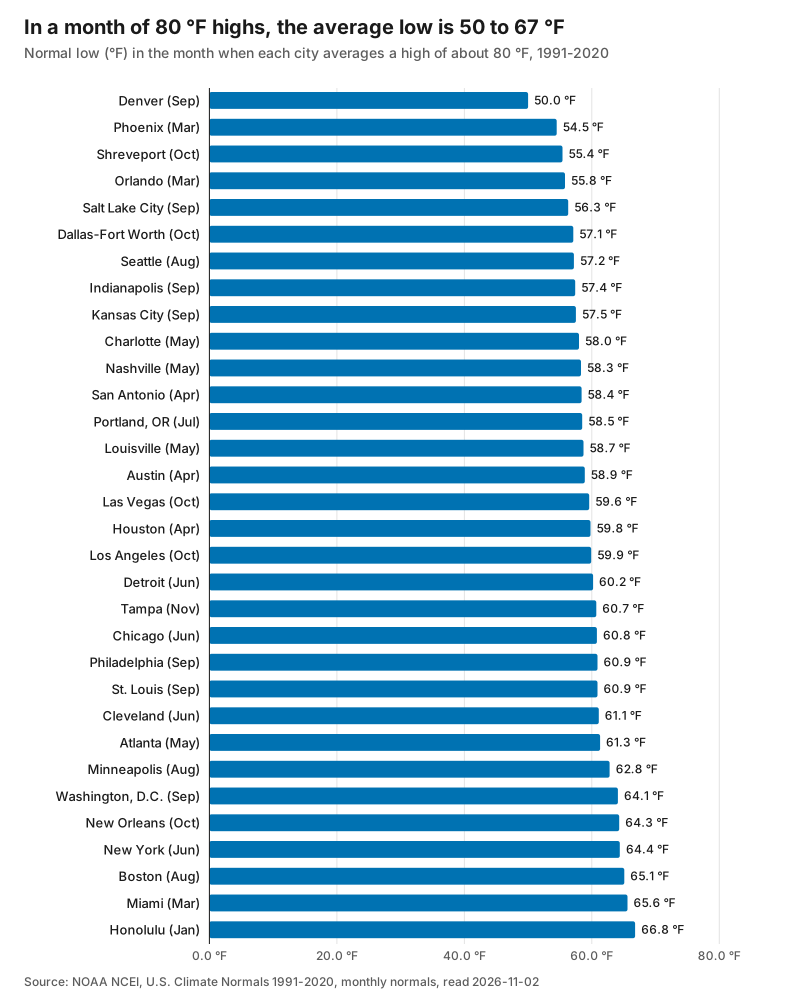
Wearton’s bands apply to the “feels like” temperature, which also includes wind, humidity and sun. The last column applies their limits to these air-temperature averages only as a comparison. Every average high is above the 18 °C (64.4 °F) line of the warm band. The average low is in the mild range in 28 of the 32 city-months, in the cold range in Denver, and in the warm range in Boston, Miami and Honolulu.
In humid air, 80 degrees feels like 81 to 86 °F (27 to 30 °C)
At 80 °F (26.7 °C) in the shade, a relative humidity of 50 to 90% gives a heat index of 80.8 to 86.3 °F (27.1 to 30.2 °C). That is the result of the National Weather Service heat index equation. The National Weather Service describes the heat index as how hot it really feels when relative humidity is combined with the air temperature. It says the values are for shady places with light wind, and that full sunshine can raise them by up to 15 °F (8.3 °C).
We calculated these values with the equation and an air temperature of 80 °F (26.7 °C). The °C results are converted from the unrounded °F results.
| Relative humidity at 80 °F (26.7 °C) | Heat index |
|---|---|
| 50% | 80.8 °F (27.1 °C) |
| 60% | 81.8 °F (27.7 °C) |
| 80% | 84.2 °F (29.0 °C) |
| 90% | 86.3 °F (30.2 °C) |
At an air temperature of 80 °F (26.7 °C) and 20 to 40% humidity, the National Weather Service equation gives a heat index just under 80 °F. At 60% humidity it gives 81.8 °F (27.7 °C) in the shade. With the National Weather Service’s full-sun addition of up to 15 °F (8.3 °C), our estimate of the upper value in full sun is 96.8 °F (36.0 °C).
Is 80 degrees hot?
80 °F (26.7 °C) is warm weather, and in humid air or full sun it can feel hot. Take an air temperature of 80 °F (26.7 °C) in shade with light wind. At 50 to 90% humidity, its calculated heat index is in the National Weather Service “Caution” class of 80 to 90 °F (26.7 to 32.2 °C): “Fatigue possible with prolonged exposure and/or physical activity”.
Full sunshine can raise the heat index by up to 15 °F (8.3 °C), the National Weather Service says. That is enough to reach its “Extreme Caution” class of 90 to 103 °F (32.2 to 39.4 °C). In that class, heat cramps, heat exhaustion or heat stroke are possible with prolonged exposure or physical activity. This is general information, not medical advice.
Light or dark colors in 80 degree weather?
For heat, wear light colors. The National Weather Service advises lightweight, loose-fitting, light-colored clothing to reflect heat and sunlight. For protection from UV rays, the CDC says that tightly woven fabric offers the best protection, and that darker colors may protect more than lighter colors. The CDC also says that a wet T-shirt protects you less than a dry one. So for a hot afternoon, we suggest light colors in a tightly woven fabric, with a hat for your face and neck.
Can you wear jeans in 80 degree weather?
Yes, you can wear jeans in 80 degree weather for a cooler morning or evening. For the warm afternoon at 80 °F (26.7 °C), we suggest thin pants, such as linen pants or light chinos, or shorts or a skirt.
Do you need sunscreen and a hat at 80 degrees?
Use the UV index, not the temperature, to plan sun protection. The EPA UV Index scale says that protection is needed from a UV index of 3: shade from late morning through mid-afternoon, broad-spectrum SPF 15 or higher sunscreen, protective clothing, a wide-brimmed hat and sunglasses. The CDC says that UV rays can reach you on cloudy and cool days. It adds that in the continental United States, they are strongest from 10 a.m. to 4 p.m. daylight saving time.
For a hat, the CDC suggests a brim all the way around that shades your face, ears and the back of your neck, in a tightly woven fabric such as canvas. As a reminder, Wearton’s tools show “SPF 30 on your face” from UV 3 and “SPF 50 + sunglasses” from UV 6. This is general information, not medical advice.
What is 80 degrees Fahrenheit in Celsius?
Eighty degrees Fahrenheit is 26.7 degrees Celsius. To convert Fahrenheit to Celsius, subtract 32 and multiply by 5/9: (80 − 32) × 5/9 = 26.7. That is above 18 °C (64.4 °F), the line where Wearton’s tools move from the “mild” to the “warm” band.
What to do next
Check the forecast for every hour you will be outside: the light outfit is for the hottest hour, and the layer for the coolest.
- Check the morning, the afternoon and the evening of your day in What to wear tomorrow, or of the next seven days in What to wear this week. For the “feels like” temperature now, use What to wear today, which needs no sign-up.
- Wear light, loose clothes for an afternoon around 80 °F (26.7 °C). Choose the layer for the morning and evening by its hourly “feels like” temperature: a light layer when it is mild, and a warm knit or a light coat when it feels like 50 °F (10 °C) or less.
- For a cooler day, read what to wear in 70 degree weather and what to wear in 60 degree weather.
In the Wearton web app, the Today page shows an outfit of the day made from the clothes you own. After a day out, it asks how you felt, and moves your personal “feels like” temperature up or down.
You know your colors. Now see which of your clothes match them, and what to wear today.