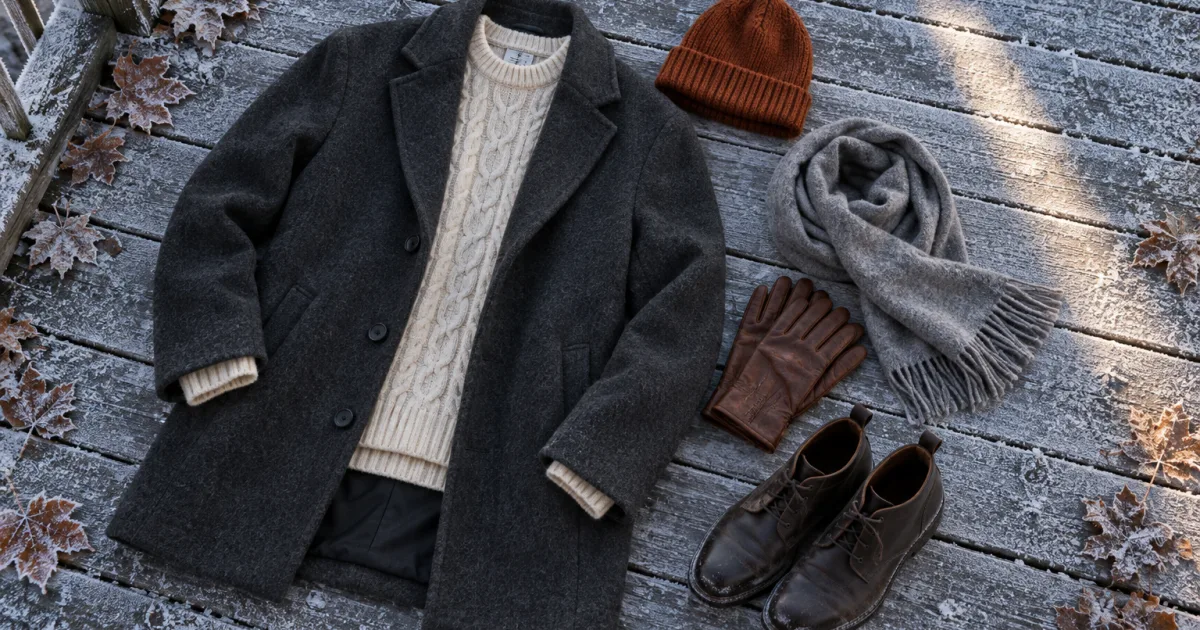
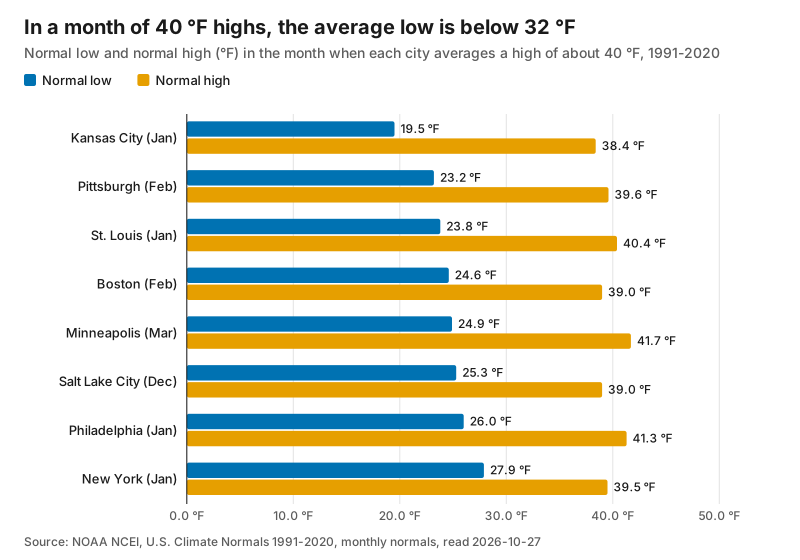
What to wear in 40 degree weather (4.4 °C): a long-sleeve top, a sweater or fleece and a warm coat, with long pants and closed shoes. Add a hat and gloves when the morning is below freezing. The low of a 40 degree day can be below freezing. In the NOAA 1991-2020 climate normals, eight chosen US cities have a month with an average high of about 40 °F (4 °C). In that month, their average low is 19.5 °F (−6.9 °C) in Kansas City to 27.9 °F (−2.3 °C) in New York.
Wearton’s What to wear tomorrow and What to wear this week tools show the morning, the afternoon and the evening of each day for your city. So you can see how cold your 40 degree day starts before you choose the coat.
The low of a 40 degree day can be below freezing
In the NOAA 1991-2020 normals of eight US cities, the month with an average high of about 40 °F (4 °C) has an average daily low of 19.5 to 27.9 °F (−6.9 to −2.3 °C). Every one of these lows is below 32 °F (0 °C), the freezing point of water. These are monthly averages for eight chosen city-months. They do not tell you the low of one particular day.
NOAA’s National Centers for Environmental Information (NCEI) publish climate normals: a normal is the 30-year average of a measurement, and the current set covers 1991 to 2020.
We screened 18 NOAA stations in 17 large US cities. Nine of the cities have a month with an average daily high from 37.5 to 42.5 °F (3.1 to 5.8 °C). The table shows eight of them: Cleveland also qualified and is left out to keep the table short, and New York uses its Central Park station. For each city, we took the qualifying month whose average high is closest to 40 °F (4.4 °C), from the NOAA monthly normals of these stations, and subtracted the average daily low from the average daily high.
| City and month | Average high | Average low | High minus low |
|---|---|---|---|
| Kansas City, January | 38.4 °F (3.6 °C) | 19.5 °F (−6.9 °C) | 18.9 °F (10.5 °C) |
| Pittsburgh, February | 39.6 °F (4.2 °C) | 23.2 °F (−4.9 °C) | 16.4 °F (9.1 °C) |
| St. Louis, January | 40.4 °F (4.7 °C) | 23.8 °F (−4.6 °C) | 16.6 °F (9.2 °C) |
| Boston, February | 39.0 °F (3.9 °C) | 24.6 °F (−4.1 °C) | 14.4 °F (8.0 °C) |
| Minneapolis-St. Paul, March | 41.7 °F (5.4 °C) | 24.9 °F (−3.9 °C) | 16.8 °F (9.3 °C) |
| Salt Lake City, December | 39.0 °F (3.9 °C) | 25.3 °F (−3.7 °C) | 13.7 °F (7.6 °C) |
| Philadelphia, January | 41.3 °F (5.2 °C) | 26.0 °F (−3.3 °C) | 15.3 °F (8.5 °C) |
| New York (Central Park), January | 39.5 °F (4.2 °C) | 27.9 °F (−2.3 °C) | 11.6 °F (6.4 °C) |
Wearton’s What to wear tools sort the “feels like” temperature into three bands. At 10 °C (50 °F) or less it is “cold”: a warm knit and a coat, and closed shoes. Every average high and every average low in the table is below the 10 °C (50 °F) limit of the cold band. The tools apply that limit to the forecast “feels like” temperature of your city, not to these 30-year averages.
The NOAA normals are averages over 30 years, not a forecast. A single 40 degree day can start warmer or colder, so check the forecast for the hours you will be outside.
Wind makes 40 degrees feel like freezing
At 40 °F (4.4 °C), a wind of 15 mph (24 km/h) gives a wind chill of 32 °F (−0.1 °C) by the National Weather Service wind chill formula. The National Weather Service defines wind chill only at or below 50 °F (10 °C) and for wind above 3 mph (4.8 km/h). Wind chill is based on how fast exposed skin loses heat in wind and cold.
We calculated these estimated wind chills with the formula, an air temperature of 40 °F (4.4 °C) and wind from 5 mph (8 km/h) to 30 mph (48 km/h). The °F results are rounded to whole degrees. The °C results are converted from the unrounded °F results and rounded to one decimal place. Wind speeds in km/h are rounded to whole numbers.
| Wind at 40 °F (4.4 °C) | Wind chill |
|---|---|
| 3 mph (4.8 km/h) or less | Not defined by the National Weather Service formula |
| Light breeze, 5 mph (8 km/h) | 36 °F (2.5 °C) |
| Breezy, 10 mph (16 km/h) | 34 °F (0.9 °C) |
| Windy, 15 mph (24 km/h) | 32 °F (−0.1 °C) |
| Very windy, 20 mph (32 km/h) | 30 °F (−0.8 °C) |
| Strong wind, 25 mph (40 km/h) | 29 °F (−1.5 °C) |
| Very strong wind, 30 mph (48 km/h) | 28 °F (−2.0 °C) |
A wind chill below freezing at an air temperature of 40 °F (4.4 °C) does not mean that the wind alone will freeze a puddle. The National Weather Service says that wind does not cool an object below the actual air temperature, and that the air itself has to be below freezing for frostbite to develop on exposed skin.
What to wear in 40 degree weather, from morning to afternoon
For a 40 degree day, we suggest dressing for the coldest hour you will be outside, and taking off the hat and gloves when the afternoon is calm and sunny. The table is our suggestion for each kind of hour.
| Your 40 °F (4.4 °C) day | What to wear |
|---|---|
| A morning forecast below 32 °F (0 °C) | A warm coat over a sweater or fleece, a hat, gloves and a scarf, long pants, closed shoes or boots |
| Afternoon, about 40 °F (4.4 °C), calm and sunny | A sweater or fleece and a coat; the hat and gloves can go in your bag |
| Afternoon, windy, 15 mph (24 km/h) or more | A coat that blocks the wind, a scarf, a hat and gloves, trousers rather than a skirt |
| Rain likely | A water-resistant coat over the warm layer, water-resistant shoes or boots, no suede |
| Hours outside standing still, for example at a game | One more warm layer, warm socks, and the hat and gloves all day |
| A run or a brisk walk | Fewer layers than for standing still, because you warm up as you move; gloves and a hat you can take off |
Wearton’s tools give two tips for wind and rain. At 20 km/h (12 mph) of wind or more, they say that skirts will fly and to wear trousers. When the chance of rain is 40% or more, they say to leave the suede at home.
How to layer for 40 degree weather
For 40 °F (4.4 °C), we suggest three layers that you can take off one by one, and covered skin in wind. Choose how warm each layer is by the wind, the rain, your activity and how cold you usually feel. For extreme cold, the CDC lists a hat, gloves or mittens, a scarf, a water-resistant coat and boots, and several layers of loose-fitting clothing. For a 40 degree day, we suggest the same pieces in lighter weights.
- Start with a long-sleeve top or a thin thermal top.
- Add a warm layer: a sweater, a fleece or a thick cardigan.
- Put on a warm coat. Choose one that blocks the wind on a windy day, and a water-resistant one when rain is likely.
- Wear jeans or long pants. With a skirt or a dress, add thick tights.
- Wear closed shoes or boots with warm socks.
- Take a hat, gloves and a scarf for the morning and for wind. Wind chill is about exposed skin, so cover your hands, ears and neck.
Is 40 degrees cold enough for a winter coat?
Yes, for most 40 degree days we suggest a warm coat. Forty degrees Fahrenheit (4.4 °C) is in the “cold” band of Wearton’s tools, which suggest a warm knit and a coat. On a calm, sunny afternoon, a lighter coat over a thick sweater can be enough for a short time outside. In wind of 15 mph (24 km/h) or more, the National Weather Service formula gives a wind chill of 32 °F (−0.1 °C) or lower, so choose a warm coat that blocks the wind.
Do you need a hat and gloves at 40 degrees?
At 40 °F (4.4 °C), we suggest a hat and gloves for a morning below freezing and for wind, because they cover skin that would be bare. A hat keeps your head warm in the same way that gloves and a scarf keep your hands and neck warm: by covering exposed skin.
In a 2008 paper in the BMJ, Rachel Vreeman and Aaron Carroll of the Indiana University School of Medicine found that the head loses no special share of body heat. They checked the claim that “40 to 45 percent of body heat” leaves through the head. The figure is in a 1970 US Army survival manual, and probably came from an old military study of people in arctic survival suits without hats. The authors wrote: “Any uncovered part of the body loses heat and will reduce the core body temperature proportionally.”
What should you wear in 40 degree rain?
In 40 degree rain, we suggest a water-resistant coat over your warm layer, and water-resistant shoes or boots, because wet clothes make you cold. The CDC says that hypothermia can occur even at cool temperatures above 40 °F (4.4 °C) if a person becomes chilled from rain, sweat or cold water. Change out of wet clothes when you can. This is general information, not medical advice: the CDC page lists the signs of hypothermia and what to do.
What is 40 degrees Fahrenheit in Celsius?
Forty degrees Fahrenheit is 4.4 degrees Celsius. To convert Fahrenheit to Celsius, subtract 32 and multiply by 5/9: (40 − 32) × 5/9 = 4.4. That is below 10 °C (50 °F), the upper limit of the “cold” band of Wearton’s tools.
What to do next
Check the forecast for every hour you will be outside, and dress for the coldest one.
- Check the morning, the afternoon and the evening of your day in What to wear tomorrow, or of the next seven days in What to wear this week. For the “feels like” temperature now, use What to wear today, which needs no sign-up.
- Take off the coat or the warm layer indoors, and put the hat and gloves back on for the evening.
- For warmer days, read what to wear in 50 degree weather and what to wear in 60 degree weather.
In the Wearton web app, the Today page shows an outfit of the day made from the clothes you own, and leaves suede shoes and suede coats out when the chance of rain is 40% or more. After a day out, it asks how you felt, and moves your personal “feels like” temperature up or down.
You know your colors. Now see which of your clothes match them, and what to wear today.