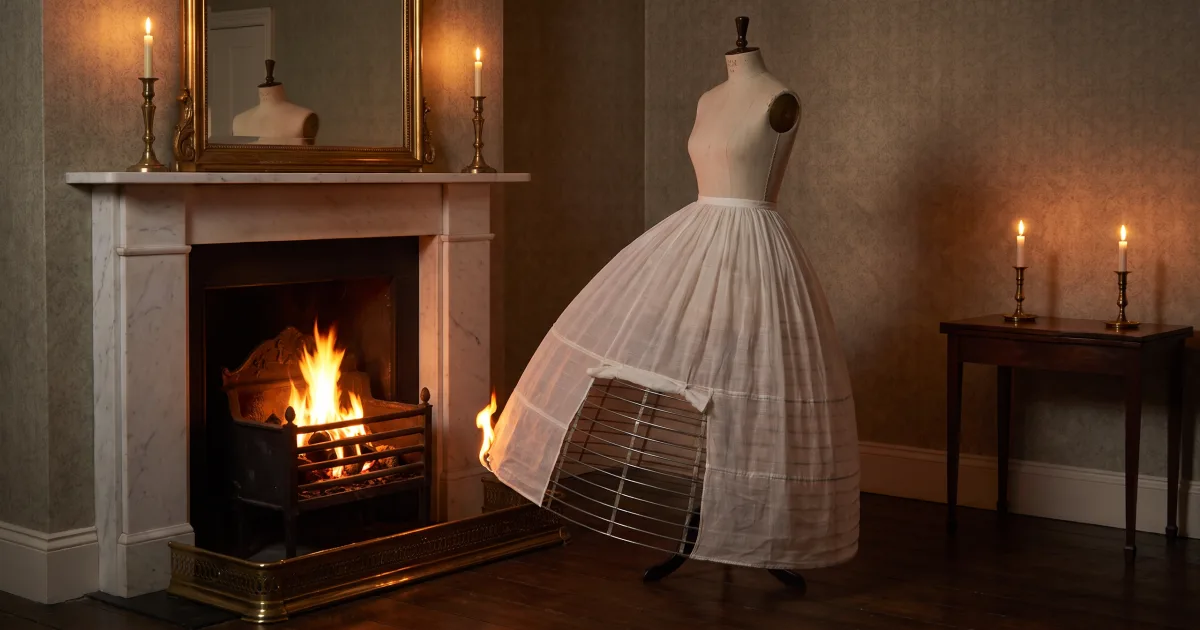
A crinoline is a stiff underskirt that holds a skirt out wide. The word first meant a stiff fabric of horsehair or cotton: Merriam-Webster records that sense from 1829. From 1857, says the Victoria and Albert Museum (V&A), it also meant the cage crinoline, a frame of steel hoops hung on tapes under the skirt. One cage of the 1860s in the V&A measures 36.6 in (93 cm) across.
Most answers to “what is a crinoline” stop at the definition. This page goes on to the fires: what the records of the 1850s and 1860s counted, and the salt that two chemists found in 1859 to stop muslin from flaming. It comes from a 46-second history film by Wearton, the AI wardrobe app, Your skirt swings into the fire, which shows the cage swinging into the grate. Wearton reads your skin tone from a selfie in its phone app, keeps your closet and suggests what to wear today. We checked every quote against the original page.
The word crinoline first meant a horsehair fabric
Merriam-Webster gives 1829 as the first known use of the word for “an open-weave fabric of horsehair or cotton that is usually stiffened”. The name came into English from French, and into French from the Italian crinolino. Its two parts are crino, horsehair, from the Latin crinis, hair, and lino, flax or linen, from the Latin linum.
Stiff underskirts made of that fabric took its name. Merriam-Webster’s second meaning is “a full stiff skirt or underskirt made of crinoline”, and also a hoopskirt. The Cambridge Dictionary gives the meaning most readers want today: “a stiff frame worn under a skirt to give it a full appearance, especially in the 19th century”.
What is a crinoline made of?
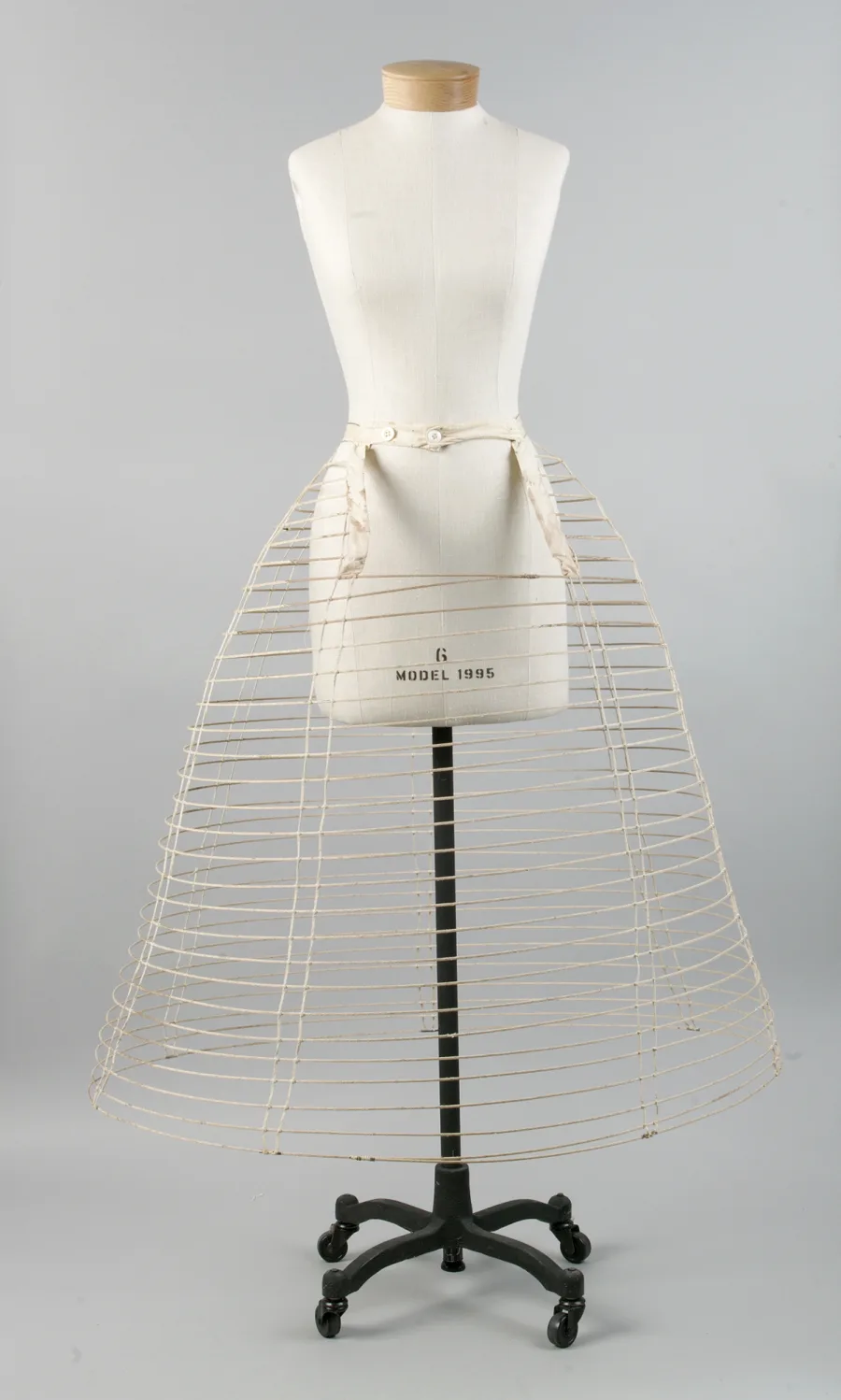
A cage crinoline is made of steel hoops covered with cotton, hung at fixed heights on vertical bands of tape. It did the work of the stiff underskirt with a light frame. The V&A says that the “‘artificial’, or ‘cage’ crinoline appeared in 1857 as a welcome and more practical alternative”. An 1859 US patent by E. F. Woodward describes how such a skirt was built: hoops “of metallic band or wires covered with cotton fabric”, “suspended by perpendicular bands of tape”. The patent protects a train added to the hoop skirt. So it shows how a cage was usually built in 1859, not who invented it.
The cages were large. The V&A keeps a cage of 1860 to 1865, probably made by Thomson & Co., with the name “A Favorite of the Empress”. It measures 36.6 in (93 cm) across, 31.5 in (80 cm) from waist to hem, and 92.5 in (235 cm) round the bottom.
The Metropolitan Museum of Art in New York keeps a crinoline of about 1860, made of metal and cotton. The photo below shows it on a stand: the rings of covered metal grow wider from the waist to the hem, and vertical tapes hold them at fixed heights.
Why did crinolines catch fire so easily?
A dress worn over a cage crinoline caught fire easily because the cage held its wide skirt of light material out from the body, where it could touch an open grate. In 1861, Charles Dickens’s weekly All the Year Round described how a raised arm swung the cage and the fabric into the bars. “By this action of the arm you suddenly sway forward the steel petticoat, and so bring the whole mass of light material which is above it in contact with the bars. In a moment all is in a blaze.”
The fabric made it worse. In one case that All the Year Round reported in 1861, a young woman “was dressed in white muslin”, a thin cotton cloth, when her sleeve caught fire. Cotton is a plant fiber, and the chemists Fred. Versmann and Alphons Oppenheim explained in 1859 that plant fiber “communicates ignition, by burning with a flame”. They wrote that animal fiber, such as wool, “chars when in contact with a flame, but is not itself inflammable”. That was their finding in 1859, not a modern fire-safety rating of wool.
Once the dress was alight, it was hard to put out. Punch wrote on 22 December 1866: “When the dress catches fire, it cannot be extinguished, because of the air under it.”
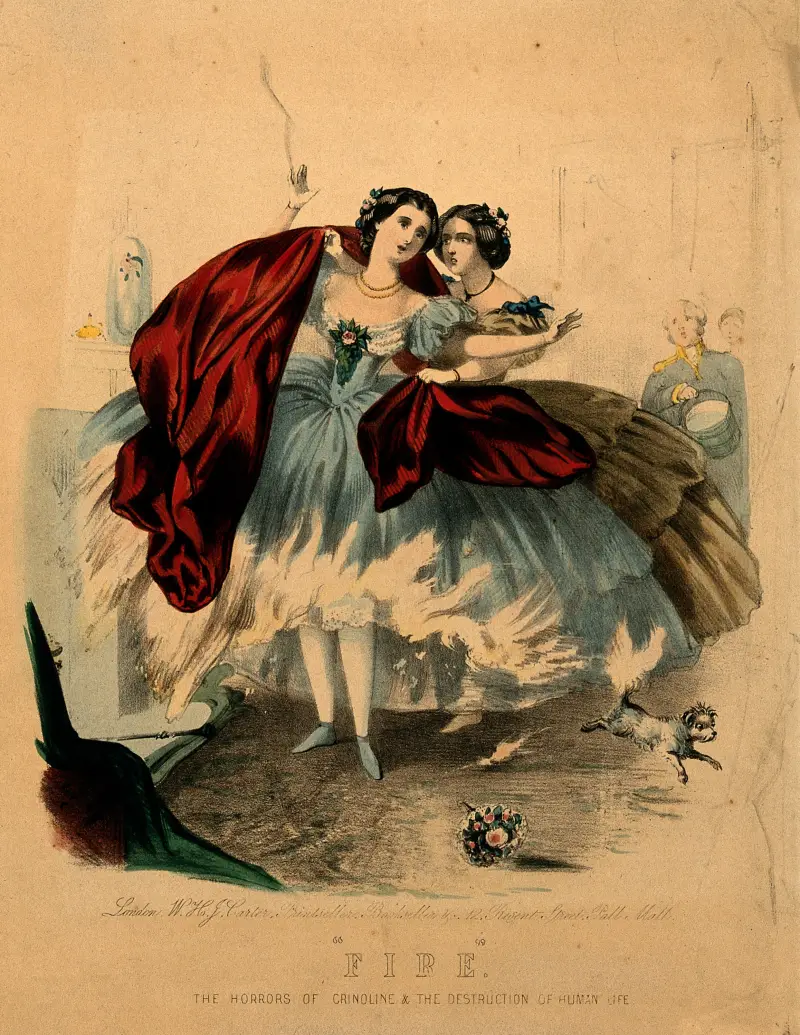
All the Year Round called fire accidents to women “disastrously common” in 1861. A colored lithograph of about 1860 in the Wellcome Collection shows the fear of the time. A woman’s wide skirt is in flames next to a fireplace, and a second woman covers her with a red cloth. The words under the picture are “The horrors of crinoline & the destruction of human life”.
How many women died in crinoline fires?
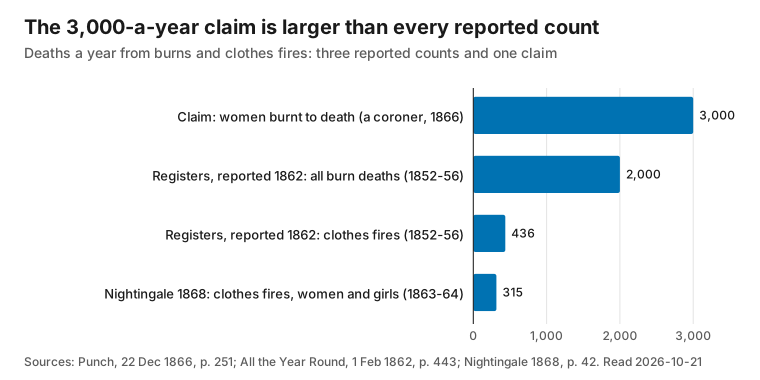
The records quoted here count deaths from clothes catching fire, and they give no separate total for crinolines. Florence Nightingale wrote in London in 1868 that in the two years 1863 and 1864, “no fewer than 630 females, of all ages, were burnt to death by their clothes catching fire”. That is 315 women and girls a year, from every kind of clothes fire, not only from crinolines (Notes on Nursing for the Labouring Classes, p. 42). Her page does not name the area, and it is a minimum. Nightingale added that the Registrar-General recorded “a far greater number of deaths by fire” among women “where the manner is not stated”.
Nightingale also gave her own estimate for “the crinoline age”. If that age starts at 10, she wrote, “then 277 lives are known to have been sacrificed by fire during two years only to this absurd and hideous custom”. Her 277 are the girls and women over 10 among the 630, and she blamed all of those deaths on the crinoline.
For the years before the cage, All the Year Round reported in 1862, quoting the civil registers of England and Wales, that they had 9,998 deaths from burns in the five years from 1852 to 1856. Of those, 2,181 “are stated to have been caused by clothes taking fire”. That is about 2,000 burn deaths a year, and about 436 a year from clothes fires, for people of all ages and both sexes.
The figure of 3,000 a year is a claim, not a count
A much larger number comes from Punch. On 22 December 1866 it quoted an unnamed coroner from The Times: “There were 3000 women burnt to death annually in England and Wales”. That is more than every count reported in the sources here, but the counts are not directly comparable: their years, people and causes differ, and Nightingale’s page does not name its area. None of them gives a total for crinoline deaths. Punch itself doubted the number in the same issue. “We must perhaps take with some grains of salt the statement that three thousand women annually fall martyrs to hooped petticoats.” The chart below compares the claim with the three reported counts.
A salt that stopped muslin from flaming was found in 1859
A way to stop muslin from burning with a flame was known from 1859. The London papers printed letters about light dresses and curtains catching fire, and Queen Victoria “desired the Master of the Mint to report to her on this important subject”. The Master of the Mint, Professor Graham, gave the work to the chemists Versmann and Oppenheim. They “compared the value of forty different salts soluble in water”. On 15 September 1859 they read their results to the British Association in Aberdeen (the 1859 pamphlet, Wellcome Collection).
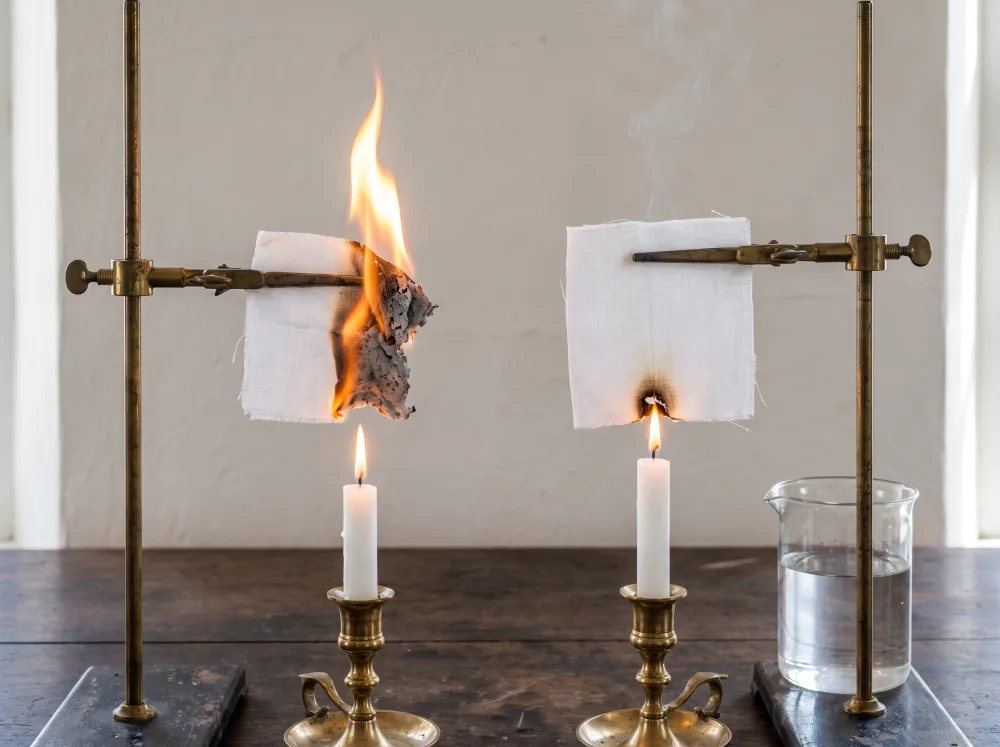
The salt that Versmann and Oppenheim recommended for laundries was tungstate of soda. “A solution containing twenty per cent. renders the muslin perfectly non-inflammable,” they wrote. In their test, treated muslin “was destroyed only in that part which was in immediate contact with the flame”. It charred where the flame touched it, and the fire did not spread. This was an experiment of 1859, not fire-safety advice for today: the treated muslin was still destroyed where the flame touched it.
The picture below is a generated illustration of that test, not a photo of their experiment: the plain square of muslin burns, and the dipped square only chars.
The chemists wrote that the salt “has been introduced into Her Majesty’s laundry, where it is constantly being used”. By 1862 it was “sold by all our principal chemists”, in bottles labeled “Tungstate of soda, for rendering muslin, &c., non-inflammable”, under the name “Ladies’ Life Preserver” (All the Year Round, 1 February 1862).
The treatment did not last. Versmann and Oppenheim wrote that the salts “require to be renewed after the prepared fabrics have been washed”.
Why did women not use the fire-resistant salt?
All the Year Round explained in 1862 that many women ignored the fire-resistant salt because it did not make their dresses look better. That was the magazine’s own view, not a count of women’s reasons. Its words were cautious: “It is much to be feared” that the indifference “is in great measure attributable to the fact that this discovery in no sort adds to the beauty of the material”.
Writers of the time also recommended other additives in the starch. At an inquest reported by All the Year Round in 1861, Dr Gull claimed that a little sulphate of soda would make light dresses “perfectly incombustible, at the cost of about one-tenth of a farthing per dress”. Florence Nightingale advised “putting alum into starch” in 1868. These are historical recommendations, not fire-safety advice for today.
Older salts had a practical problem. Versmann and Oppenheim wrote that none of the salts recommended before them “have found favour with the public, none of them allowing the iron to pass smoothly over the fabric”. Tungstate of soda is “very smooth, and of a fatty appearance, like talcum”, and “this property facilitates the ironing process, which all other salts resist”.
Is a crinoline the same as a petticoat?
A crinoline is one kind of petticoat: a stiff one, or one held out by hoops. Merriam-Webster defines a petticoat as “a skirt worn by women, girls, or young children”, most often “an underskirt usually a little shorter than outer clothing”. It defines a crinoline as “a full stiff skirt or underskirt made of crinoline”, or a hoopskirt. So a crinoline worn under a skirt is a petticoat, but a soft cotton petticoat is not a crinoline.
What to do next
The film and the pamphlet show the story in more detail.
- Watch the 46-second Wearton film “Your skirt swings into the fire” to see the cage swing into the grate and the test of the two squares of muslin.
- Read the table on page 27 of the Versmann and Oppenheim pamphlet for every salt they tested and why they recommended it or not.
You know your colors. Now see which of your clothes match them, and what to wear today.