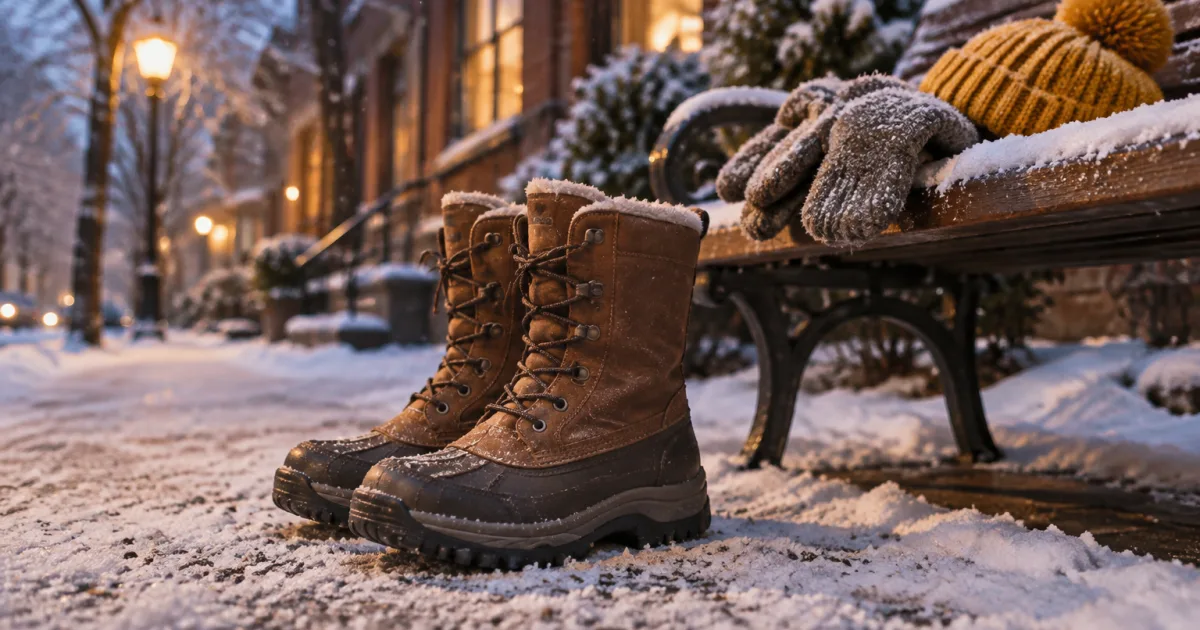
What to wear in 30 degree weather, 30 °F (−1.1 °C): a thermal top, a sweater or fleece and an insulated coat, with long pants, warm socks and insulated boots with treads. Add a hat over your ears, a scarf, and mittens or gloves. In the NOAA 1991-2020 climate normals, 13 of the 32 US cities we screened have a month with an average high of about 30 °F (−1 °C). Its average low is much colder: 7.2 °F (−13.8 °C) in Bismarck to 19.2 °F (−7.1 °C) in Detroit.
Wearton’s What to wear tonight tool shows how your evening will feel until midnight, and takes its advice from the coldest hour. What to wear tomorrow shows the morning, the afternoon and the evening of the next day for your city. With them, you can see how cold your 30 degree day gets before you choose a coat.
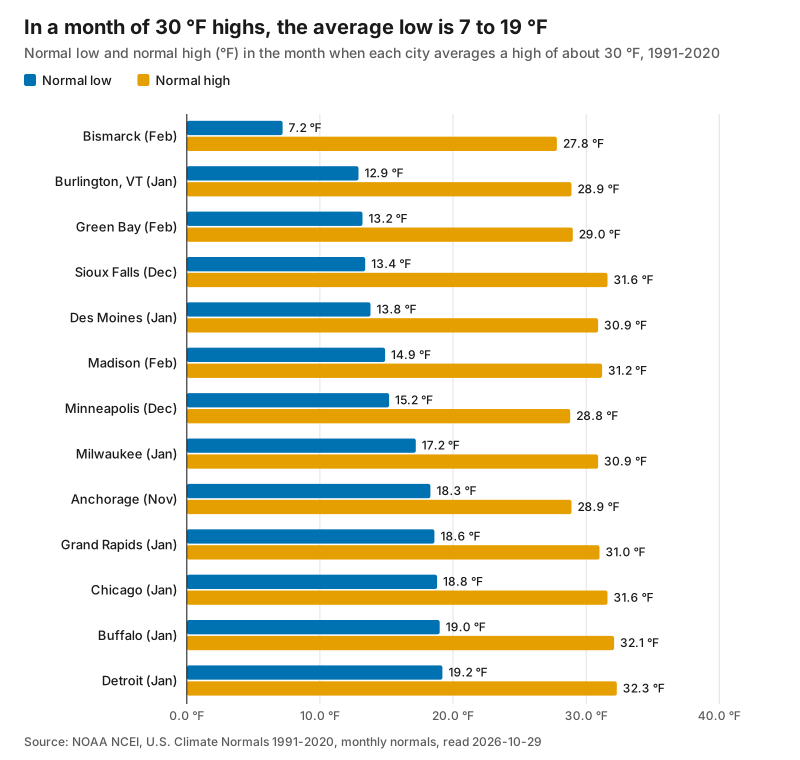
In a month of 30 degree highs, the average low is 7 to 19 °F (−14 to −7 °C)
We screened 32 US cities in the NOAA 1991-2020 normals, and 13 of them have a month with an average high near 30 °F (−1 °C). In those 13 city-months, the average daily low is 7.2 to 19.2 °F (−13.8 to −7.1 °C). That is 10.6 to 20.6 °F (5.9 to 11.4 °C) below the average high of the same month. These are monthly climate averages for 13 chosen city-months. They do not predict the low of one particular 30 degree day.
How we chose the 13 cities
NOAA’s National Centers for Environmental Information (NCEI) publish climate normals: a normal is the 30-year average of a measurement, and the current set covers 1991 to 2020.
We screened 33 NOAA stations in 32 US cities: 18 stations in 17 large cities and 15 stations in northern cities. Thirteen cities have a month with an average daily high from 27.5 to 32.5 °F (−2.5 to 0.3 °C), and the table shows all 13. For each city, we took the qualifying month whose average high is closest to 30 °F (−1.1 °C), from the NOAA monthly normals of all 33 stations. We subtracted the average daily low from the average daily high. The snowfall column is the average snowfall total of that month.
| City and month | Average high | Average low | High minus low | Average snowfall |
|---|---|---|---|---|
| Bismarck, February | 27.8 °F (−2.3 °C) | 7.2 °F (−13.8 °C) | 20.6 °F (11.4 °C) | 7.5 in (19.1 cm) |
| Burlington, Vermont, January | 28.9 °F (−1.7 °C) | 12.9 °F (−10.6 °C) | 16.0 °F (8.9 °C) | 21.1 in (53.6 cm) |
| Green Bay, February | 29.0 °F (−1.7 °C) | 13.2 °F (−10.4 °C) | 15.8 °F (8.8 °C) | 12.0 in (30.5 cm) |
| Sioux Falls, December | 31.6 °F (−0.2 °C) | 13.4 °F (−10.3 °C) | 18.2 °F (10.1 °C) | 8.7 in (22.1 cm) |
| Des Moines, January | 30.9 °F (−0.6 °C) | 13.8 °F (−10.1 °C) | 17.1 °F (9.5 °C) | 9.4 in (23.9 cm) |
| Madison, February | 31.2 °F (−0.4 °C) | 14.9 °F (−9.5 °C) | 16.3 °F (9.1 °C) | 12.8 in (32.5 cm) |
| Minneapolis-St. Paul, December | 28.8 °F (−1.8 °C) | 15.2 °F (−9.3 °C) | 13.6 °F (7.6 °C) | 11.4 in (29.0 cm) |
| Milwaukee, January | 30.9 °F (−0.6 °C) | 17.2 °F (−8.2 °C) | 13.7 °F (7.6 °C) | 14.9 in (37.8 cm) |
| Anchorage, November | 28.9 °F (−1.7 °C) | 18.3 °F (−7.6 °C) | 10.6 °F (5.9 °C) | 12.6 in (32.0 cm) |
| Grand Rapids, January | 31.0 °F (−0.6 °C) | 18.6 °F (−7.4 °C) | 12.4 °F (6.9 °C) | 22.6 in (57.4 cm) |
| Chicago (O’Hare), January | 31.6 °F (−0.2 °C) | 18.8 °F (−7.3 °C) | 12.8 °F (7.1 °C) | 11.3 in (28.7 cm) |
| Buffalo, January | 32.1 °F (0.1 °C) | 19.0 °F (−7.2 °C) | 13.1 °F (7.3 °C) | 26.7 in (67.8 cm) |
| Detroit, January | 32.3 °F (0.2 °C) | 19.2 °F (−7.1 °C) | 13.1 °F (7.3 °C) | 14.0 in (35.6 cm) |
Wearton’s What to wear tools sort the “feels like” temperature into three bands. At 10 °C (50 °F) or less it is “cold”: a warm knit and a coat, and closed shoes. Every average high and every average low in the table is below the 10 °C (50 °F) limit of the cold band. The tools apply that limit to the forecast “feels like” temperature of your city, not to these 30-year averages.
Wind makes 30 degrees feel like 15 to 25 °F (−9.5 to −4 °C)
At 30 °F (−1.1 °C), a wind of 5 to 30 mph (8 to 48 km/h) gives a wind chill of 25 to 15 °F (−4.0 to −9.5 °C). That is the result of the National Weather Service wind chill formula. Wind chill is based on how fast exposed skin loses heat in wind and cold. The National Weather Service defines it only at or below 50 °F (10 °C) and for wind above 3 mph (4.8 km/h).
We calculated these estimated wind chills with the formula, an air temperature of 30 °F (−1.1 °C) and wind from 5 mph (8 km/h) to 30 mph (48 km/h). The °F results are rounded to whole degrees. The °C results are converted from the unrounded °F results and rounded to one decimal place. Wind speeds in km/h are rounded to whole numbers.
| Wind at 30 °F (−1.1 °C) | Wind chill |
|---|---|
| 3 mph (4.8 km/h) or less | Not defined by the National Weather Service formula |
| Light breeze, 5 mph (8 km/h) | 25 °F (−4.0 °C) |
| Breezy, 10 mph (16 km/h) | 21 °F (−6.0 °C) |
| Windy, 15 mph (24 km/h) | 19 °F (−7.2 °C) |
| Very windy, 20 mph (32 km/h) | 17 °F (−8.1 °C) |
| Strong wind, 25 mph (40 km/h) | 16 °F (−8.9 °C) |
| Very strong wind, 30 mph (48 km/h) | 15 °F (−9.5 °C) |
The formula assumes no sun. The National Weather Service says that bright sunshine may raise the wind chill by 10 to 18 °F (5.6 to 10 °C). So a calm, sunny afternoon at 30 °F (−1.1 °C) can feel much milder than a windy evening at the same temperature.
What to wear in 30 degree weather, from morning to evening
For a 30 degree day, we suggest dressing for the coldest hour you will be outside, and taking off a layer before you start to sweat. The table is our suggestion for ordinary outings on a day near 30 °F (−1.1 °C), not advice for extreme cold. Check the local weather alerts, and adjust for wind, wet weather, activity and time outside.
| Your 30 °F (−1.1 °C) day | What to wear |
|---|---|
| A colder morning or evening of a 30 degree day, below 20 °F (−6.7 °C) | A thermal top, a sweater or fleece, an insulated coat, a hat over the ears, a scarf, mittens, warm socks and insulated boots |
| Afternoon, about 30 °F (−1.1 °C), calm and sunny | A long-sleeve top, a sweater or fleece and an insulated coat, with a hat and gloves |
| Windy, 15 mph (24 km/h) or more | A coat that blocks the wind, with a hood, a scarf or knit mask over the face, mittens, and trousers rather than a skirt |
| Snow, or ice on the sidewalks | Insulated, water-resistant boots with good rubber treads, a water-resistant coat, no suede |
| Hours outside standing still, for example at a game | One more warm layer, thermal leggings under your pants, and warm socks |
| A run or a brisk walk | Fewer layers than for standing still, because you warm up as you move, with gloves and a hat you can take off |
Wearton’s tools give two tips for wind and rain. At 20 km/h (12 mph) of wind or more, they say that skirts will fly and to wear trousers. When the chance of rain is 40% or more, they say to leave the suede at home.
How to layer for 30 degree weather
For 30 °F (−1.1 °C), we suggest three loose layers and covered skin. OSHA, the US workplace safety agency, advises people who work outside in winter to wear at least three layers of loose-fitting clothing. The steps follow its advice, with our suggestions for pants and shoes.
- Start with an inner layer of wool, silk or a synthetic fabric such as polypropylene. OSHA says these keep moisture away from the body and hold more body heat than cotton.
- Add a middle layer of wool or a synthetic fleece. OSHA says it insulates even when wet.
- Put on an outer layer that blocks wind and rain and lets some air through, so you do not overheat. The National Weather Service says outer garments should be tightly woven, water repellent and hooded.
- Wear long pants, with thermal leggings under them for hours outside. With a skirt or a dress, add thick tights.
- Wear warm socks and insulated, waterproof boots.
- Keep every layer loose. OSHA says tight clothing reduces blood circulation, and the National Weather Service says the air trapped between the layers insulates you.
What shoes should you wear in 30 degree weather?
In 30 degree weather, we suggest insulated, water-resistant boots with good rubber treads, because snow and ice can make sidewalks slippery. OSHA calls such boots “a must for walking during or after a winter storm”, and notes that layers of ice can form as the temperature drops. It also suggests rubber over-shoes with good treads that fit over your street shoes. On an icy or snow-covered walkway, OSHA advises short steps and a slower pace, so you can react to a change in traction.
Can you wear jeans in 30 degree weather?
Yes, for a short trip. At 30 °F (−1.1 °C), we suggest jeans without thermal leggings only for a short time outside, such as a walk from the car to a building. For hours outside, we suggest thermal leggings of wool or a synthetic fabric under the jeans, as the inner layer. OSHA says that inner layers of wool, silk or polypropylene hold more body heat than cotton.
Do you need a hat, gloves or mittens at 30 degrees?
Yes. At 30 °F (−1.1 °C), we suggest a hat that covers your ears, a scarf, and mittens or gloves, to cover exposed skin. The National Weather Service says that mittens, snug at the wrist, are better than gloves. OSHA says a hat that covers your ears helps keep your whole body warmer.
The National Weather Service also says that much of your body heat can be lost from your head. In a 2008 BMJ article on medical myths, Rachel Vreeman and Aaron Carroll of the Indiana University School of Medicine explained that the head loses no special share of body heat. They wrote: “Any uncovered part of the body loses heat and will reduce the core body temperature proportionally.” Either way, a hat covers bare skin, as gloves and a scarf do.
Can you get frostbite at 30 degrees?
You cannot rule frostbite out at 30 °F (−1.1 °C), because the air is below freezing. The National Weather Service says that frostbite develops on exposed skin only when the air temperature near the skin is below freezing, whatever the wind chill. Its example of skin that can freeze in 30 minutes is much colder: 0 °F (−17.8 °C) air and a 15 mph (24 km/h) wind, a wind chill of −19 °F (−28.3 °C).
The CDC says frostbite usually affects the nose, ears, cheeks, chin, fingers and toes. Redness or pain in any skin area may mean that frostbite is beginning: get out of the cold or protect the exposed skin. Other signs are a white or grayish-yellow skin area and skin that feels unusually firm or waxy. This is general information, not medical advice.
Is 30 degrees Fahrenheit the same as 30 degrees Celsius?
No. Thirty degrees Fahrenheit is −1.1 degrees Celsius, just below the freezing point of water, and 30 degrees Celsius is 86 degrees Fahrenheit. To convert Fahrenheit to Celsius, subtract 32 and multiply by 5/9: (30 − 32) × 5/9 = −1.1. This guide covers clothing for 30 °F (−1.1 °C), not for hot weather at 30 °C (86 °F).
What to do next
Check the forecast for every hour you will be outside, and dress for the coldest one.
- Check the coldest hour of your evening in What to wear tonight, or the morning, the afternoon and the evening of your day in What to wear tomorrow. For the “feels like” temperature now, use What to wear today, which needs no sign-up.
- When the forecast shows snow or ice, put on boots with good treads before you leave, and take short steps on icy sidewalks.
- For milder days, read what to wear in 40 degree weather and what to wear in 50 degree weather.
In the Wearton web app, the Today page shows an outfit of the day made from the clothes you own. After a day out, it asks how you felt, and moves your personal “feels like” temperature up or down.
You know your colors. Now see which of your clothes match them, and what to wear today.